
Beetroot shots, salty gels and a pinch of bicarb — the supplement aisle is louder than ever. Here's an honest look at what works for the rest of us: not the elites chasing tenths, not the back-of-pack plodding for fun, but the club runner trying to claw a minute or two off a 10K.
If you've ever stood in a sports shop staring at a wall of gels, powders and pinkish shots wondering whether any of it is worth the money — welcome. You're not alone. The good news is that sports science has actually done the work for us. Most of what's on those shelves is, charitably, optional. But a small handful of supplements have been tested again and again in proper trials, and they consistently deliver real, measurable performance gains for runners like us.
This is the bit that often gets buried in the marketing: the people who benefit most from these supplements aren't the elites. Elite athletes are already so close to their physiological ceiling that a 1% gain is huge but hard-won. For club runners with a bit of headroom — that's most of us — the same supplement can deliver 2-3% gains. On a 50-minute 10K, that's well over a minute. That's not nothing.
Sports nutrition bodies (the IOC and the Australian Institute of Sport in particular) classify supplements by how strong the evidence is. I've borrowed that approach and grouped the things you'll actually encounter into four tiers, ordered by likely impact for a club runner. The dosages are taken from current consensus reviews — treat them as starting points, not gospel.
| Supplement | Best for | Typical dose & timing | Evidence |
|---|---|---|---|
| Tier 1 — The Big Three (proven, practical, worth your money) | |||
| Caffeine Coffee, tablets, gum, gels |
Everything from parkrun to marathon. Reduces perceived effort, sharpens focus. | 3–6 mg/kg, ~45–60 min before | Strong |
| Carbohydrate (gels, drinks, chews) Maurten, SiS, Tailwind, High5... |
Anything over ~75 minutes. The single biggest factor in late-race fade. | 30–60 g/hr (up to 90 g/hr if trained) | Strong |
| Beetroot juice (nitrate) Beet It shots, raw juice |
5K to half-marathon. Improves running economy — you go the same pace for less effort. | ~6.4–12.8 mmol nitrate, 2–3 hr before | Strong (for non-elites) |
| Tier 2 — Worth a try (works, with caveats) | |||
| Sodium bicarbonate Bog-standard baking soda |
Hard, short efforts: 800m up to ~10K. Buffers lactic acid. | ~300 mg/kg, 60–180 min before | Good |
| Beta-alanine Capsules / powder |
Same niche as bicarb — sustained high-intensity efforts. Needs loading. | 3–6 g/day for 4–10 weeks | Good |
| Creatine monohydrate Cheap, generic powder |
Strength, hill repeats, recovery between sessions. Less direct for endurance. | 3–5 g/day, every day | Good |
| Electrolyte drinks/tabs SiS Hydro, Precision, Nuun |
Hot-weather running, heavy sweaters, runs over ~90 min. | Per pack — aim for sodium, not sugar | Context-dependent |
| Tier 3 — Foundational, not magic (fix deficiencies, no extra benefit) | |||
| Iron | If blood test shows low ferritin (common in female runners). Otherwise, no. | Test first. Talk to GP. | Only if deficient |
| Vitamin D | UK winters — most of us are low. Bone health and immunity. | ~10 µg/day Oct–Mar (NHS guidance) | Health basis |
| Protein powder | Convenience. No advantage over chicken and yoghurt if you eat enough. | Aim for ~1.4–1.6 g/kg/day total intake | Convenience only |
| Tier 4 — Save your money | |||
| BCAAs, glutamine, ketone esters (for most), most "recovery" blends, antioxidant megadoses (vitamin C/E in high doses can actually blunt training adaptation), tart cherry juice (tiny effect), exotic mushroom blends. The evidence is either thin, mixed, or actively unhelpful. Skip | |||
Reading the table: "Strong" means multiple high-quality trials show consistent benefit. "Good" means it works, but with practical caveats (gut tolerance, loading periods, individual response).
Caffeine is the most thoroughly studied legal performance aid on earth. It works by blunting your perception of effort: the same pace simply feels easier. The sweet spot is 3–6 mg per kg of body weight, taken about an hour before you race. For a 70 kg runner, that's roughly two double espressos — drunk an hour before the gun goes off, because absorption peaks at 30–60 minutes.
One thing worth knowing: you don't need to abstain beforehand. The old "caffeine taper" advice has largely been disproven. Drink your normal coffee in training, take a slightly bigger dose pre-race, and you'll get the effect.
This is the single biggest performance lever in any race over about 75 minutes. Your glycogen stores run out somewhere around the 90-minute mark of hard running, and when they go, you don't slow down gracefully — you fall off a cliff. Hence "the wall."
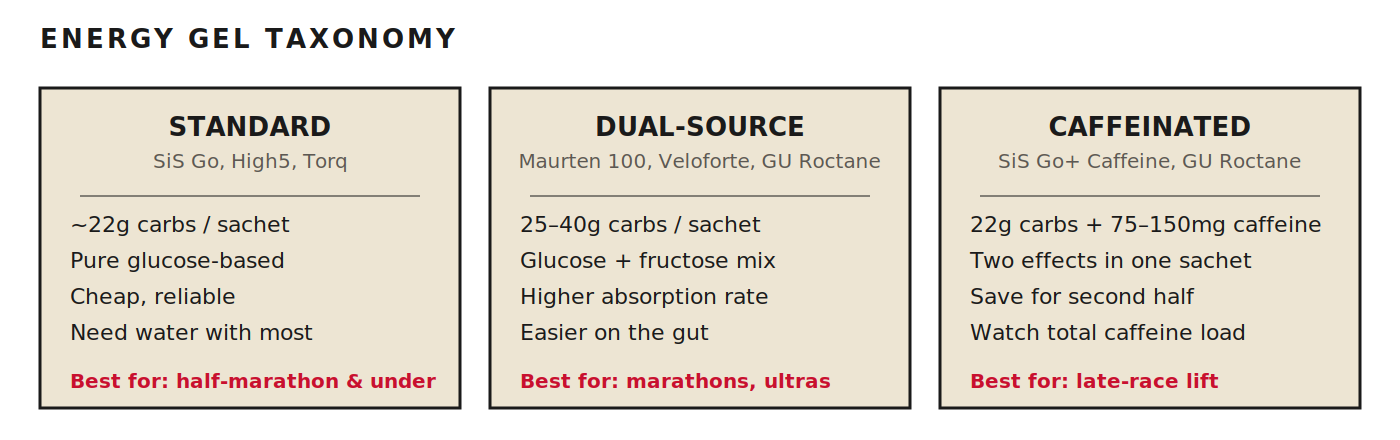
Modern guidance is more aggressive than it used to be. 30–60 g of carbohydrate per hour for a half-marathon, and trained runners can push to 90 g/hr for a marathon by mixing glucose and fructose (which is what Maurten and similar gels do). The key practical point: train your gut. Don't try a new fuelling strategy on race day — that's how you end up sprinting for a hedgerow at mile 18.
Beetroot juice is rich in inorganic nitrate, which your body converts to nitric oxide. Nitric oxide widens blood vessels and makes your muscles more efficient at using oxygen. The trial data is interesting: in elite athletes the effect is small or absent, but in recreational and club-level runners the gains are consistent and meaningful — often 1–3% improvement in time-trial performance. That's a perfect club-runner supplement.
Use a concentrated shot (Beet It or similar — one shot is ~6.4 mmol nitrate; some studies use two), taken two to three hours before your race. Yes, your urine will go pink. No, that's not a problem. Yes, your teeth might too. Use a straw.
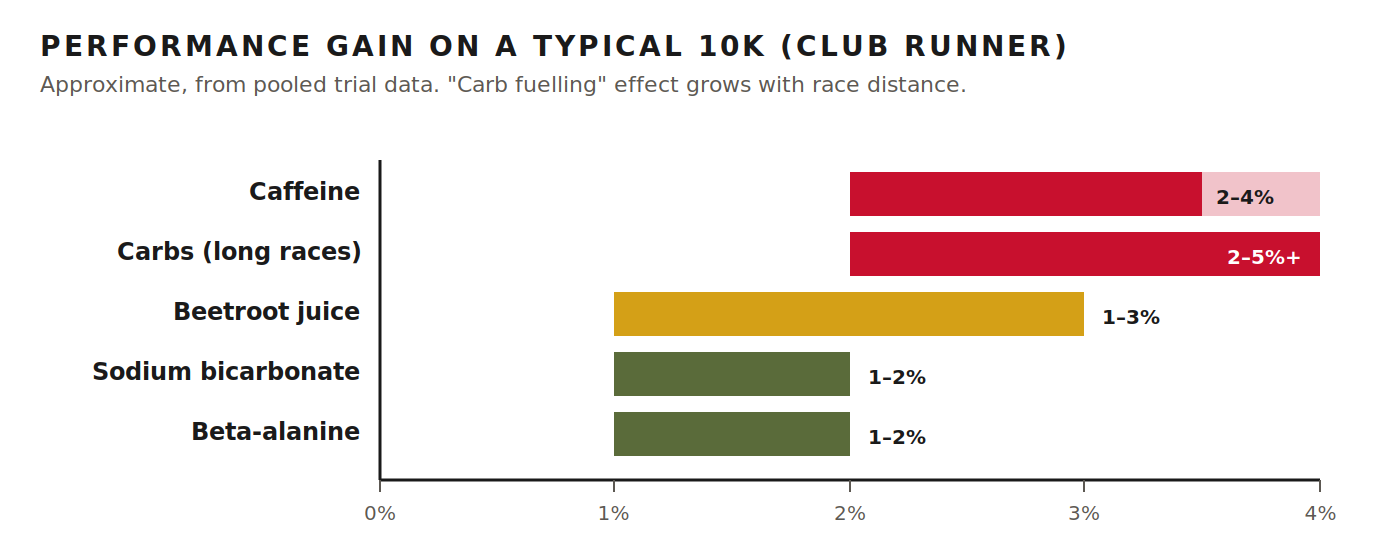
Plain old baking soda from the supermarket is, genuinely, a performance supplement. It increases your blood's buffering capacity, so you can tolerate more lactic acid before your legs revolt. Brilliant for 800m to 10K efforts.
The catch is that for many people it triggers very memorable gastric distress. If you want to try it, work up gradually in training, take it with a meal 1–3 hours before the effort, and split the dose. Newer "extended release" formulations (e.g. Maurten Bicarb System) are a lot easier on the stomach, and a lot more expensive.
Quick taxonomy of what's on the gel shelf:
The job of a sports drink is two things: deliver carbs and replace sodium lost in sweat. The classic isotonic stuff (Lucozade Sport, SiS Go Energy) does both. Pure electrolyte tabs (Nuun, Precision Hydration) are sodium-only with no carbs — useful for hot weather and heavy sweaters, but they don't replace fuel. Don't confuse the two.
For the average club run on a cool English Saturday, plain water is fine. For a 90-minute hilly long run in July when you're back at the car looking like you've been swimming, electrolytes earn their place.
Can you take all the Tier 1 stuff at once? Yes. Caffeine + carbs + beetroot is a well-evidenced combination, and the effects appear to be largely additive. The classic club-runner race-morning cocktail looks like this: beetroot shot 2–3 hours out, regular breakfast, double espresso 60 minutes out, gels every 25–30 minutes during.
What you should not do: try this combination for the first time on race day. Test the full protocol on at least two long training sessions before you trust it for a goal race.
Individual response varies enormously. Roughly 1 in 5 people are caffeine "non-responders" (genetic). Some people get massive gains from beetroot, others get almost nothing. Bicarb makes some runners fly and others vomit. Treat your own training runs as the experiment.
Supplements amplify training; they don't replace it. A sensibly trained runner who supplements smartly will beat a heavily-supplemented couch potato every time. If your weekly mileage and sleep aren't sorted, fix those first — the gains are far bigger than anything in this article.
Mind UK Anti-Doping if you're racing competitively. Everything in Tiers 1–3 is fully legal for England Athletics events. But if you ever buy "boosters" online, especially from non-EU/UK retailers, contamination is a real risk — the Informed Sport scheme exists for exactly this reason and is worth looking for on the label.
If you read nothing else, read this. In order of bang-per-buck for a Hart Road Runner trying to PB their next 10K or half:
See you on a Tuesday coached speed-work session soon! Bring the beetroot 🙂